In one trial, Kapnetix Post finished cleaning a file before the user had played it through in MotionBuilder. Your files come back the way your pipeline expects them. Nothing downstream changes.
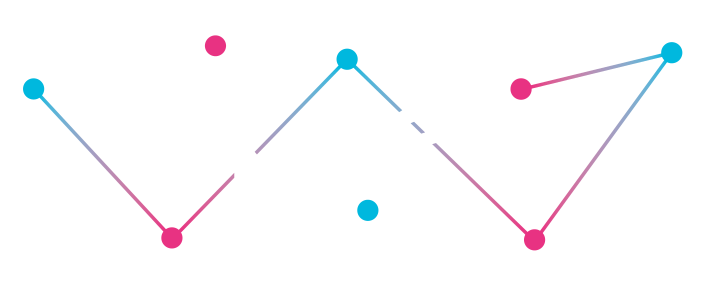
Occlusion gapsMarker swapsJitterC3D · FBX · TAK and moreCloud · on-prem · air-gapped
Automated motion capture cleanup
Building deeper understanding of complex movement.
Motion capture is the process of recording the movement of complex objects, usually people. While most people would associate it with filmmaking or animations in video games, it also has its military, sports, and medical applications.
Capturing movement is hard. While most of the market uses optical tracking, relying mostly on its high accuracy, there are also inertial systems that use sensors or solutions that are looking at tracking motion just from 2D images.
Each system has its advantages, but most require heavy post-processing and corrections. While it’s not possible to eliminate the creation of these errors, Kapnetix aims to automate the correction tasks so that people don’t have to do it.
Our approach dramatically speeds up the overall time to deliver great quality MoCap.
No need to change your existing pipeline
Kapnetix is a plug & play cloud service. It accepts common formats like FBX or C3D and returns cleaned mocap to the same place it originated. It also runs on-prem or air-gapped, inside your own network, when policy says nothing leaves the building.
Hours of boring cleanup completed in minutes
Our goal is to help animators focus on the creative process and not imperfections of the optical mocap process.
We can personalize through re-training
Creativity has no boundaries and our solution has to be ready for motion that can be very unique.
We can fix complex multicharacter scenes
We continuously challenge ourselves to solve harder problems. Multiple characters and de-noising are supported today. Props are not, and we will tell you that before you send us a shoot rather than after.
The problem
Cleanup cost is a long tail, not a volume.
Shooting is the cheap half. A day on the stage produces a week at the desk, and almost none of that week is spread evenly. It collapses onto a handful of takes nobody can identify in advance.
Today those takes are found by opening files one at a time.
So the question worth answering first is not “can you clean this?” It is “which of these 200 takes is going to cost me the day?”
The worst 10 takes of 88 hold 58% of all missing data, and 2% of gap events carry 56% of the damage.
Our own measurement across 88 real OptiTrack takes and 21,390 gap events. The only instrumented study of manual cleanup cost, MAMMA 2025, found the same shape: the expense sits in marker swaps, at 4.95 hours per sequence on swapped finger markers against 15 minutes for body markers.
01 · The run
You set the level of automation.
No black box that suddenly spits out a file. You see the plan before anything runs, tune it as far as you want, and see exactly what was done after. Let go only as your confidence grows.
01Upload
Clean on shoot day, between setups.
C3D or FBX, from shared storage or a watched folder, a take or the whole day at once. Format, capture system, actor count and duration are read from the files, so you never pick the type by hand. Raw stays immutable. Every run writes a new version beside it.
Drop your file here
Multiple files · C3D, FBX
Input file type
C3D
Motion capture source
Optical
02Triage
Spend your time on the hardest takes, not on finding them.
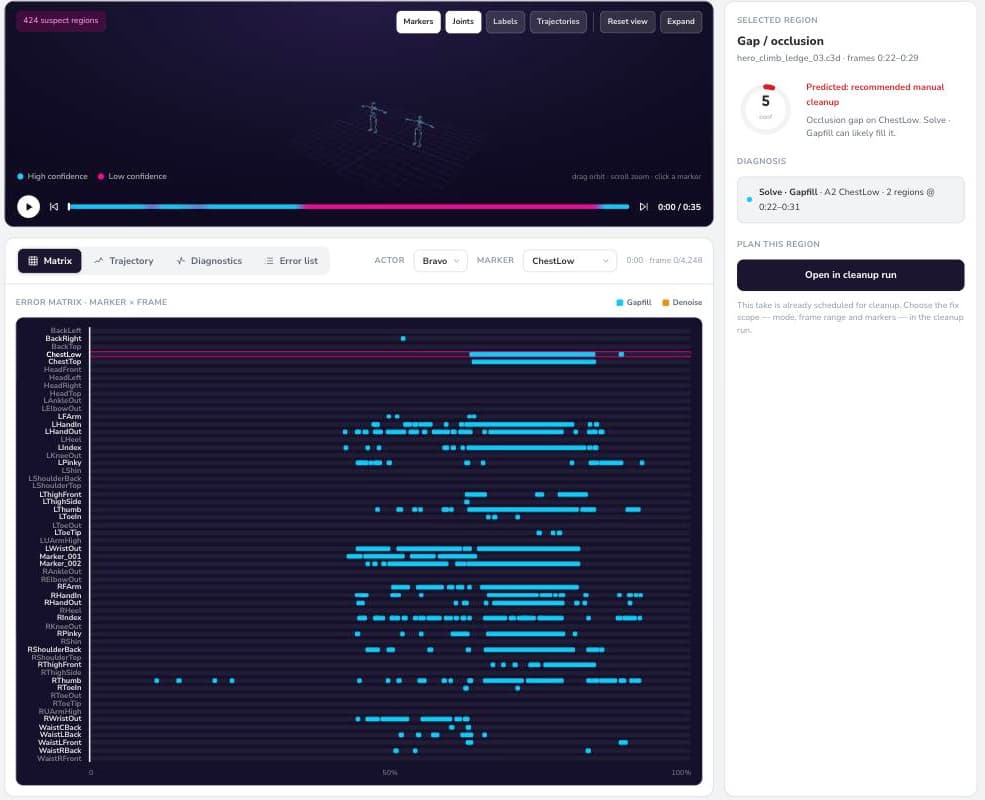
No more scrubbing ten minutes through a take to find out it was clean all along. Every file gets an error map and a per-region prediction of how well Kapnetix will do, so you know where your hands are needed before you open anything.
Gap / occlusion · frames 0:22–0:29 · confidence 5 Occlusion gap on ChestLow. Solve · Gapfill can likely fill it.
03Clean
We only touch what you scope.
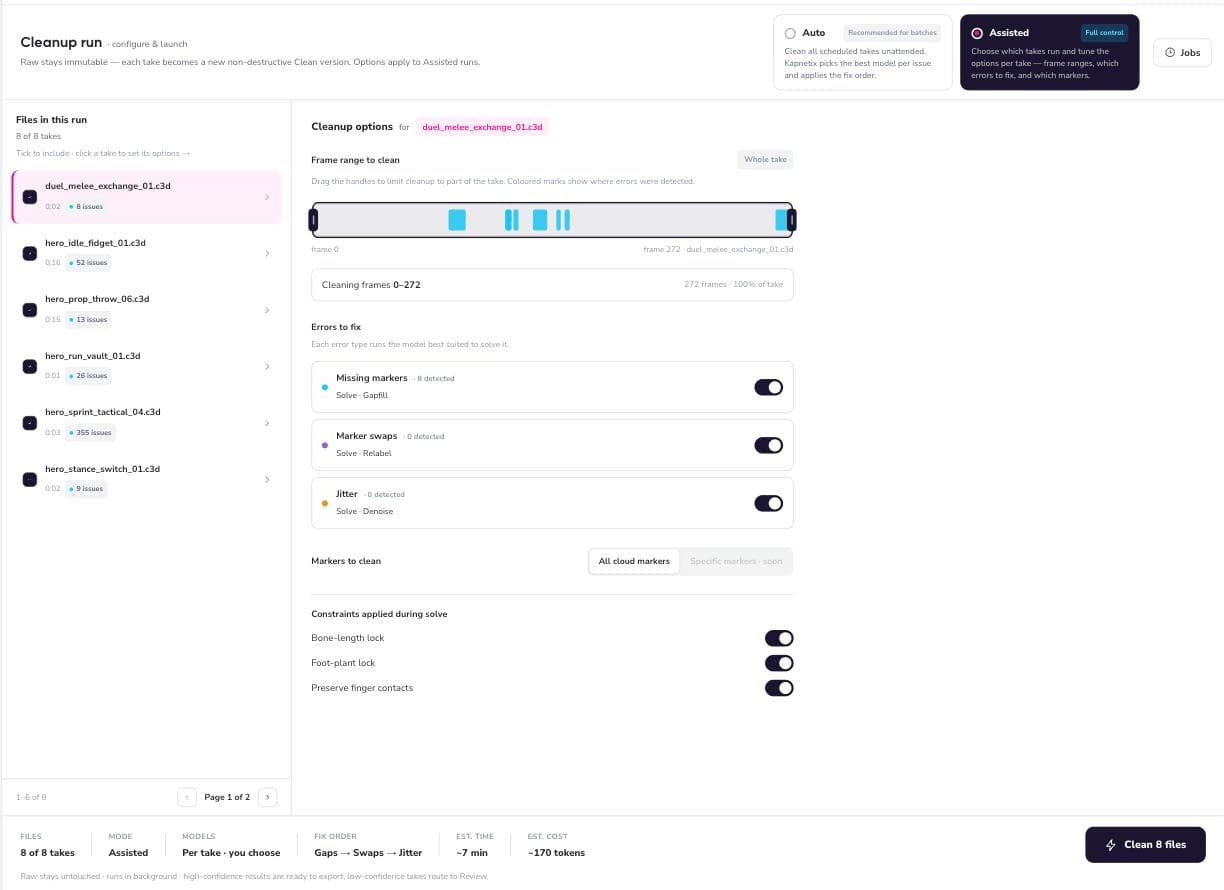
Frame range, error classes, eligible markers, and the constraints held during the solve: bone-length lock, foot-plant lock, preserve finger contacts. Turn jitter off and jitter stays. Repairs run in a fixed order, so a fix never lands on top of a mislabelled marker.
04Review
Including the takes we made worse.
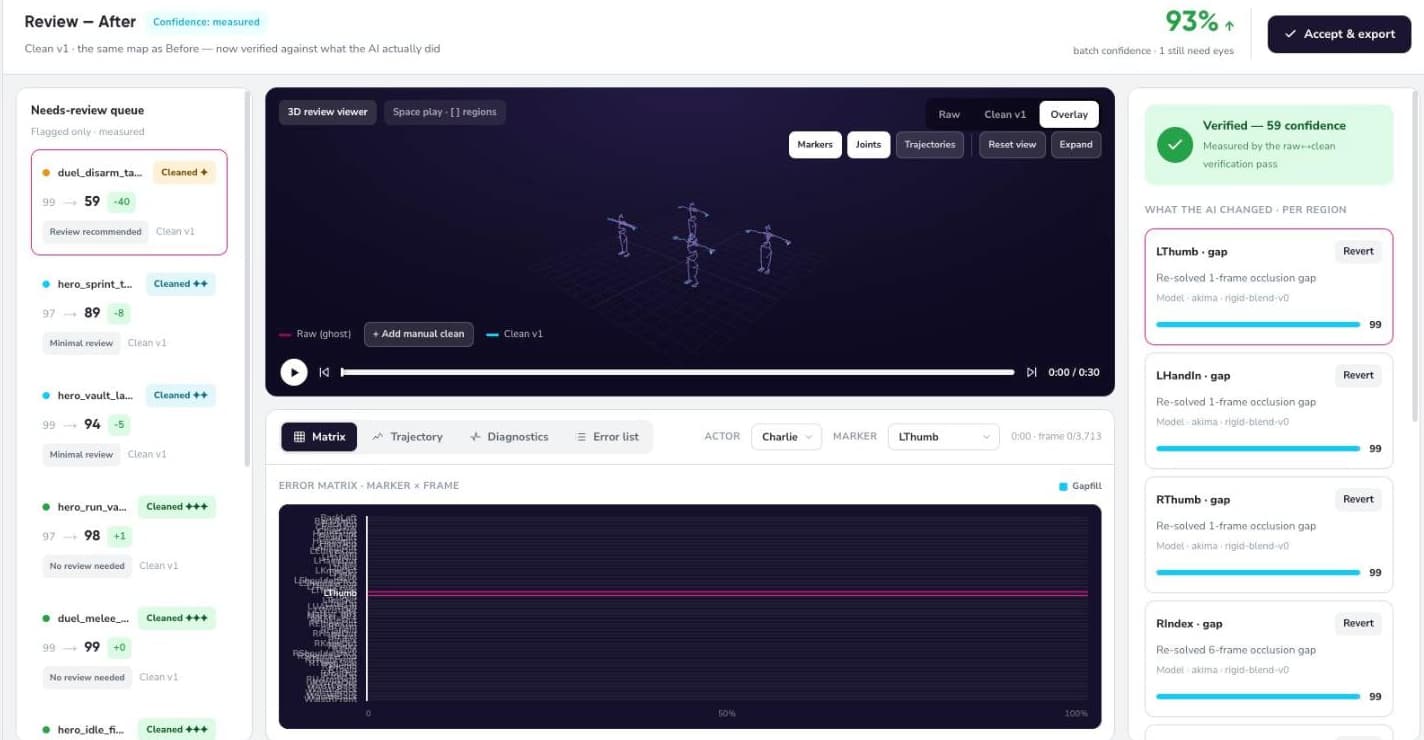
One take in this batch came back at 59, down 40 points, flagged. We show it, name the model that did it, and give every region its own revert.
Verified means we measured it. It does not mean it is good.
Needs-review queue · measured
duel_disarm_takedown_01.c3d
99→59−40Confidence fell from 99 to 59, a drop of 40 points.
Verified · measuredQuality down −40 · review recommended
Verification is a neutral fact. Quality is a separate signal, and it carries its own colour.
What the AI changed · per region
4 of 4 changes kept
LThumb · gap
Re-solved 1-frame occlusion gap
Model · akima · rigid-blend-v0
LHandIn · gap
Re-solved 1-frame occlusion gap
Model · akima · rigid-blend-v0
RThumb · gap
Re-solved 1-frame occlusion gap
Model · akima · rigid-blend-v0
RIndex · gap
Re-solved 6-frame occlusion gap
Model · akima · rigid-blend-v0
05Export
Your file back, exactly the way your pipeline expects it.
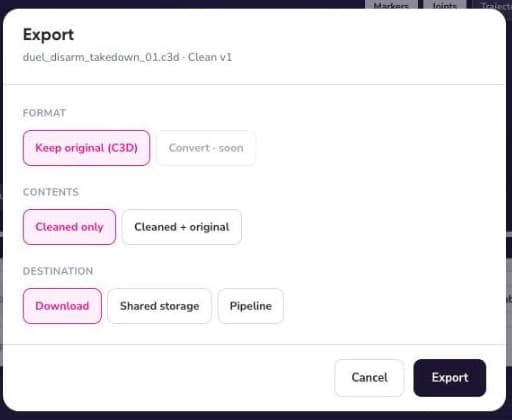
Keep original C3D. Cleaned only, or cleaned plus original. Download, shared storage, or straight into the pipeline. Nothing downstream has to change: you carry on the way you are used to.
Native FBX round-trip is validated on our demo build and not yet on production. It goes on this page the day it deploys.
02 · The instrument
Confidence is a measure of fixability, not of error.
A detector tells you something is broken. Kapnetix Post predicts how cleanly it can be repaired, then shows you the same map measured, after the run.
Real capture, 56 named markers, one 35-second take. We do not simplify this view for the site.
Proof
Measured, with the conditions attached.
Each of these comes from a run we can point at. Where a figure only holds under a condition, the condition is part of the claim.
2.7×
more accurate gap fill than interpolation
On long gaps, where interpolation collapses: 16.7 mm median error against 45.2 mm. On short gaps we are deliberately equivalent to interpolation, because that is the correct engineering answer. Batch eval, 2026-08-06, synthetic-gap holdout.
54 / 54
markers identified on a new studio's rig, with no setup
Rig identification at confidence 1.000 on a marker set the system had not seen. This is rig identification, not a statement about cleanup quality.
Deterministic
cleanup runs, per raw file, options and model
The same input with the same scope produces the same result, so a re-run is a re-run rather than a new roll of the dice.
Company-level track record belongs to Kapnetix rather than to this product: ten years of applied AI, five innovation awards, more than 50 international projects and seven clients above $1B revenue.
03 · Specs & formats
Plug and play, and honest about the edges.
Read
C3D
FBX
TAK
VDF
BVH
TRC
Write
C3D, keep original
VDF
Cleaned, or cleaned + original
FBX round-trip: validated, not deployed
Lands in
Maya
MotionBuilder
Shōgun
Deploy
Cloud
On-prem
Air-gapped
Optical capture. Performers, single and multiple. Props are not supported.
Trust
Unreleased performance is the most sensitive data in your building.
We do not need your capture to improve our models. If policy says nothing leaves the stage, run us on the stage.
AAA-grade data handling
We have handled data from some of the world's largest AAA productions.
Models trained on our own data
Base models are trained entirely on data we captured or purchased to our own spec, with full IP rights. Your takes never feed them.
Private models on your data
Bring your own data and we train a model for your use only.
Cloud, or on-prem and air-gapped
Built for enterprise wherever you choose to deploy. The same build, inside your network if that is where it has to live.
04 · Pricing
A tenth of what cleanup costs you today.
That is the target we price against for every customer. Save the money, save the week, and spend both on shooting more and better content.
How it works
One annual licence, sized to your shooting year.
Tell us how many hours of mocap you plan to shoot this year. Your licence covers that usage. No per-seat fees, no per-file surprises: the price scales with the capture, and you know it before the year starts.
01Plan your shooting hours for the year.
02Your licence covers that usage, cloud or on-prem.
03Plans change? One-time top ups, whenever you need them.
Start free
Pilot before you commit.
Start on our broken sample takes today, no approvals needed. When your data clears, we run a handful of your takes with you under NDA and quote your year from what we measure.
We onboard a small number of studios at a time, so every licence starts with a conversation, not a checkout.
Questions
What studios ask before a pilot.
What does Kapnetix Post actually do?
Kapnetix Post is the AI front end for motion-capture post-production. You upload a shoot day and it diagnoses every take, predicts how cleanly each one can be repaired, cleans the ones worth cleaning, and hands back a verified result in your own file format. Your raw capture is never modified: every cleanup lands as a new version you can inspect, compare and revert.
How long does motion capture cleanup take with Kapnetix Post?
The industry baseline is roughly one hour of footage to five working days of professional manual cleanup, about 40 artist-hours. On our own measurements, the machine work for that hour is about two hours of compute on a single laptop core, and the artist reviews the confidence map rather than opening every take by hand. The honest framing is artist-days, not realtime: cleaning runs at roughly 40 times realtime per performer, but diagnosis runs at about realtime today and is the bottleneck we are working on.
What file formats does Kapnetix Post support?
It reads FBX, C3D, BVH, TRC, TAK from OptiTrack Motive and VDF from Vicon Shogun. Exports keep the original format, including TAK and VDF, using template-based writing so the file that comes back is your own file with the animation patched in rather than a lossy re-export. Native FBX round-trip is validated on our demo build and is not yet promoted to production.
Does it fit into Maya, MotionBuilder and Shogun?
Yes. Output is validated in MotionBuilder, Maya and Shogun, and there are Maya and MotionBuilder plugins so an artist can diagnose and send from inside the tool they already have open. Zero pipeline disruption is a constraint we design to, not a feature we added: nothing downstream has to change.
What is a confidence score, and what does it measure?
Confidence is a measure of fixability, not of error. Any system can flag that something is broken. A Kapnetix confidence score predicts how cleanly a take or a region can be repaired, which is the question that changes your schedule. You see the same map twice: predicted before the run so you can plan the review, and measured after it so you can verify what came back.
What happens when a cleanup makes a take worse?
We show you. The needs-review queue ranks takes by before-and-after confidence and delta, including negative ones. Per region you see what changed, which model changed it and at what confidence, and you can revert any region, which excludes it from that clean version. When a result cannot be measured honestly it is labelled unverified rather than given a fabricated number.
Does Kapnetix clean every take automatically?
No, and it should not. Takes that arrive clean stay raw instead of being cleaned for no reason. On easy data, roughly one percent missing with gaps of one to five frames, our router sends the work to interpolation, because that is the correct engineering answer. The rule that governs a run is that the AI only touches what you scope: which takes, which frame range, which error types, which markers, and which solve constraints are held.
Does Kapnetix support props?
No. Kapnetix Post handles optical capture of performers, single and multiple, and covers occlusion gaps, marker swaps and jitter. Props are not supported. We would rather tell you that before you send a shoot than after.
Do you train your models on our capture data?
No. Base models are trained entirely on data we captured or purchased to our own specification, with full IP rights. Customer motion is never used to train shared models without an explicit agreement. If you want a model tuned to your own data, we train a private one for your use only.
Can Kapnetix run on-premise or air-gapped?
Yes. Kapnetix Post deploys as a cloud service with EU processing, on-premise with SSO and SCIM, or fully air-gapped with an offline licence bundle. Unreleased performance is the most sensitive data in a studio, so if policy says nothing leaves the stage, we run on the stage.
How is Kapnetix Post priced?
One annual licence sized to the hours of motion capture you plan to shoot that year. No per-seat fees and no per-file charges, so the price scales with the capture and you know it before the year starts. We onboard a small number of studios at a time, so every licence starts with a pilot rather than a checkout.
How do I try it on my own data?
Start on our broken sample takes today, with no approvals and no NDA needed. When your own data is cleared, send a handful of takes under NDA and we triage them with you, you scope the run, and you get the measured pass and your own files back.
05 · Next
Book a pilot
Bring a handful of takes. Or bring nothing at all: we hand you broken sample data to push through Kapnetix Post yourself, so you are not waiting on data-sharing approvals to see what it does.
Gamescom, Czech Pavilion. The same run, at the stand.
What a pilot is
01Start today on our broken sample takes, no approvals needed.
02When your data is cleared, send a handful of takes under NDA.
03We triage them and you scope the run. We clean what you scoped.
04You get the measured pass and your own files back.
Cookies
We use two, and neither is needed to read anything here. One tells us which pages get read, the other tells us which company a visit came from. Neither stores anything on your device unless you allow it, and you can change your mind from the footer at any time.